Thursday, May 4, 2017

Talking to Teens About Spiritual Things

Talking to Teens About Spiritual Things


One dad recalls a meeting he had with other fathers about how to communicate with young people about spiritual issues: In a “Rite of Passage” planning session with six other dads. Our conversation centered around how we could discuss spiritual concepts with our children, to prepare them to take their places in the church as godly men and women. However, several of the fathers stated they had never before talked with their children about spiritual matters.

You might understand the response of those men. Even if you have carefully and conscientiously nurtured faith in your children through their early years, adolescence brings changes. As a young child, your son or daughter may have accepted everything you said without question. Now there seems to be nothing but questions. In short, the season of “sermons” is over; the days of discussion have arrived.

The reason is simple: Teens want to be treated as adults. So, in order to talk with them about spiritual matters, we parents need to relate to our teens as grownups. The best place to begin is by building on the existing relationship.

Building on the Relationship

1. Spending time with your teen.
Time communicates value to teenagers; when we spend time with them, we know they are important to us. Teens want (and need) some privacy and “space,” but keep planning family activities that include them.
2. Listen more than lecture.
The time for instruction is mostly past; now it’s important to listen to our teens so we can better understand how they think. Listening creates opportunities to find out what they know, what they think, what they feel and what principles guide their lives. Here are a few ideas to help you listen more closely:

Ask open-ended questions that start with words such as how, what and why. For example: “When your prayer wasn’t answered the way you wanted, how did you feel? Why do you think God answered the way he did?”

Ask your teens to define what’s important in their culture. Ask about particular words in songs or popular phrases they use.

Praise them for their accomplishments, such as earning good grades, reaching a tough goal or making a hard decision that showed good judgment. Avoid the trap of seeing—and talking about —only their mistakes and shortcomings.

3. Express encouragement and affection, physically and verbally.
We can show our support in simple ways: a hug, a pat on the back, a kind word or compliment. Just using good manners can communicate love and respect, which are important to our young men and women. We can say “Please,” “Thank you,” and “I’m sorry” to them as well as to anyone. Being our children makes them no less deserving of our consideration.

4. Have fun together.
A ballgame. A meal at a restaurant. A drive in the country. Shopping at the mall. These are places where you can enjoy casual, non-threatening conversations and just get to know each other better. Here’s one suggestion: Schedule a weekly “date night” with your teen, with the understanding that it is for fun and will be free of heavy conversation. But be sure to blanket your time with prayer in advance.

One father made a breakfast appointment with his teenage son because he wanted to tell his son about the hopes, dreams, and prayers he had for the boy. But the father also found out that the son wanted more time—and breakfasts—with his dad. Thus began a wonderful habit. Each week, father and son went out for the breakfast, where they discussed spiritual issues and other important things. But they also spent a lot of time talking about the sports page. Communication comes easier when it is part of an on-going relationship.

5. Be vulnerable.
Teens respect honesty, and being open with them will encourage them to be open with us. Vulnerability is not a weakness; it is part of being human. Our children need to know we have problems, too. The good news is that our troubles give us opportunities to talk with our teens about how to rely on the Lord and his strength.

6. Live consistently. Values are caught, not taught.
Children look for consistency between our words and actions, especially when it comes
to our relationship with God. So we need to ask ourselves: How is my relationship with
Him? What words would the Lord use to describe my relationship with him? How often
do I pray? What do I ask God for? What happens when I pray?
7. Learn about their world.
Teens often think that adults are out of touch with the issues they face (and sometimes
they’re right!). One way to understand their world is to read some teenage magazines.
Then we can follow up on our research be asking our teens’ opinions on topics we come
across. The more we know their world, the more we will know them.
8. Be a friend.
One way we parents can show respect to our teens is to show sensitivity and other
affirmation when they are having troubles. We need to resist the urge to tease them when
they are bothered by something important to them, such as a relationship with the
opposite sex. Ephesians 4:29 tells us that we should only say “what is helpful for building
others up according to their needs, that it may benefit those who listen”—and that verse
doesn’t have an exception clause for our children!
9. Pray specifically for your teen at least once a week.
We must set aside time to pray for our children. Some parents find it helpful to fast and
pray for their kids one day a week. We can help our teens see the power of prayer when
we ask them every week what we can pray about for them. They may be concerned about
a tough exam or a friendship that’s run aground. They might even talk about a temptation
that they are struggling with.
At the end of the week, remember to tell your teen you were praying for him or her.
Together, you will see how God answers your prayers.
Talking Spiritual
As your relationship develops, you will find more and more opportunities to discuss deep,
spiritual matters. Here are some key topics and questions to cover—but don’t be limited by this
list. Be prepared to talk about any questions, doubts or discoveries your teen has.
1. Your teen’s personal relationship with God.
Try asking your teen, “If God were to describe your relationship with him, what words
would He use? What makes you feel this way?”
2. Purity and holiness.
Ask, “How would you describe ‘purity’ to your best friend? Why? When I say the word
‘holy’, what comes to mind, and why?”
3. Prayer.
Ask, “How does prayer fit into your daily life? If prayer is spiritual breathing, what
chokes it out of your schedule? What is the biggest question you have about prayer?”
4. Relationships.
As an icebreaker, you might say, “Describe a relationship between a boy and a girl that
honors God. What limits are important for you to maintain in a relationship that glorifies
God? Whom do you know that sets a good example in a boy-girl relationship? What
makes it good?”
5. Honor.
Ask your teen, “How do you honor a friend of yours? Why? How does that friend honor
you?”
“Impress Them on Your Children”
God gave parents the responsibility to talk with children about Him, to pray with them and help
them grow in their own faith (Deuteronomy 6:4-7; Psalm 78:1-8). When we talk with our teens
about spiritual things, our honesty, patience, vulnerability and willingness to make time for them
can open the doors to the life in Christ we hope for them and the relationship God himself
desires.
Talking in Your Teen’s World
Parents can wonder if the teen in their family has come from another country—or maybe another
planet. That’s how hard communication can seem, even in the best relationships. How can you
encourage open, honest discussion with your teen? Try some of these ideas.
1. Plan your communication.
Good communication requires a proper mood and setting, as well as good timing. Some
parents find that going for a long drive with their teen once a week is a great way to
create discussion time. Not only is there a “captive audience,” but your conversation may
feel less intimidating because you are talking side by side, not face to face. The two of
you may be in a much better position, literally, to have a great discussion.
2. Have a discussion, don’t preach a sermon.
A conversation is like a tennis game: To keep the match going, the ball must be hit back
and forth. Rather than dictating conclusions or discounting their ideas, use questions and
thoughtful responses to coach your teen’s thinking and help them learn to think and speak
clearly about important issues.
3. Engage them in non-threatening, thought-provoking conversation.
Ask your teen’s opinions on different issues. Talk about the news you hear or read, or
open a discussion about a TV program you watch together. Remember: If you respect
your teen’s opinions, it’s likely they will respect yours (even if they don’t say so).
4. Make it easy for your teen to be honest.
One couple created a report card so their son and daughter could grade them on their
relationship. It looked like this:
Dad (Mom) shows me he (she) loves me ___
Dad (Mom) is fair in his (her) decisions ___
Dad (Mom) is interested in my feelings ___
Dad (Mom) admits when he (she) is wrong ___
Dad (Mom) spends enough time with me ___
Dad (Mom) controls his (her) anger and words ___
Dad (Mom) listens to what I say ___
Dad (Mom) is fun ___
Dad (Mom) trusts me ___
Dad (Mom) respects me ___
Dad (Mom) enjoys being with me ___
Dad (Mom) provides spiritual leadership ___
Dad (Mom) makes me a priority in his (her) life ___
Overall grade ___
One a scale from 1 to 10 (10 is best), what kind of relationship do you want with Dad
(Mom)? ____
On the same scale, where are you today in your relationship with Dad (Mom)?
If your Dad (Mom) could change three things to raise his or her grade to a 10, what
would they be?
1.
2.
3.
In Deuteronomy 6:4-7, God instructs parents to teach children about following him. In
what three areas of your spiritual walk would you like your dad or mom to help?
1.
2.
3.
This approach opens the door for great conversations. But be careful when using this
process. This isn’t a time to defend your position; you can only ask questions to clarify a
response. Remember: “Do not embitter your children, or they will become discouraged”
(Colossians 3:21).
Note: Some of the ideas in this section are adapted from the books Faithful Parents, Faithful
Kids, by Greg P. Johnson and Mike Yorkey (Tyndale) and Raising Responsible Kids, by Jay Kesler

Thursday, April 13, 2017

The Kangaroo Court of Jesus

The Kangaroo Court of Jesus
There is so many issues with the trial(s) of Jesus. Listed are a few, my prayer is this helps you grow in your walk with Christ.
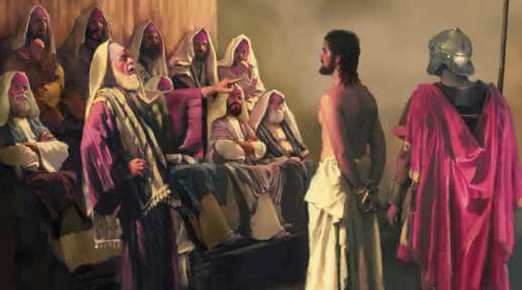
In recent years, Americans have been bombarded by one sensational criminal trial after another—each one, it seemed, the "trial of the century." Ironically, this exposure may have given us new eyes for appreciating the details of what Christians believe to be the trial of all time: Jesus bar Joseph v. Sanhedrin.
In the New Testament, the Sanhedrin trial of Jesus refers to the trial of Jesus before the Sanhedrin (a Jewish judicial body) following his arrest in Jerusalem and prior to his dispensation by Pontius Pilate. It is an event reported by all four Canonical gospels of the New Testament, although John's Gospel does not explicitly mention a Sanhedrin trial in this context.
Jesus is generally quiet, does not mount a defense, and rarely responds to the accusations, but is condemned by the Jewish authorities when he will not deny that he is the Son of God. The Jewish leaders then take Jesus to Pontius Pilate, the governor of Roman Judaea, and ask that he be tried for claiming to be the King of the Jews.
The trial as depicted in the Gospel accounts is temporally placed informally on Thursday night and then again formally on Friday morning

The arrest, trial, conviction, sentencing and execution of Jesus Christ was and still is without legal precedent. He suffered the death penalty even though Pontius Pilate – the local Roman authority – found Him innocent.  


The Messiah actually underwent two trials with three phases each. First came the religious trial where the charge was blasphemy; then came the civil trial where the charge was incitement to rebellion. 
Jesus was tried before a “kangaroo court”. This is how the dictionary refers to a kangaroo court – (An unfair, biased, or hasty judicial proceeding that ends in a harsh punishment; an unauthorized trial conducted by individuals who have taken the law into their own hands, a proceeding and its leaders who are considered corrupt and without regard for the law). Like all such trials, it was preceded by a conspiracy: “Then the chief priests and the elders of the people assembled in the palace of the high priest, whose name was Caiaphas, and they schemed to arrest Jesus secretly and kill him. “But not during the festival,” they said, “or there may be a riot among the people.” (Matthew 26:3-5) 

The conspiracy included the Pharisees, the elders of the people, the Sadducees and the chief priests. These were two opposing camps and there was a great bitterness between them. But they had one thing in common; animosity towards the claims of the Messiah. While Jesus upheld the Law of Moses, He refused to uphold the traditions of either the Pharisees or the Sadducees. This was the reason He was hated by both groups. This hatred gave rise to a conspiracy against the Messiah, which was lead by Caiaphas, the High Priest. The plan was to arrest Jesus in secret, away from the attention of the masses, and kill Him before the people became aware of what had happened. 
Matthew 26:14-16, Mark 14:11 and Luke 22:5 clearly declare that the conspirators were glad when Judas offered the opportunity to apprehend Jesus. They quickly made a promise to pay him for his services. The amount agreed upon was thirty pieces of silver. Judas was paid out of the “Temple” money that had been designated for the purchase of sacrifices. Little did the conspirators realize that they were indeed purchasing a sacrifice with temple money, for when the Messiah died, he died as the sin-sacrifice for all men. 
The thirty pieces of silver had further meaning. According to Exodus 21:32 “If the bull gores a male or female slave, the owner must pay thirty shekels of silver to the master of the slave. . .” Thus, the leaders of Israel held the ministry of the Messiah to be the value of a slave. Yet at the same time, unknown to them, these leaders were fulfilling an Old Testament Prophecy. Zechariah 11:12 clearly states that His price would be thirty pieces of silver. Read Zechariah 11:12-13. 


By the time of the Messiah, Judaism had developed a large body of law controlling every facet of Jewish life, which in the Scriptures is referred to as the tradition of the elders (read Mark 7:3-4).  
Within this massive body of law were the commandments that dealt with the manner in which the Sanhedrin was to conduct a trial. 
The main thing that the Pharisees and Sadducees had against the Messiah was His refusal to accept the traditions as being authoritative and binding. Yet they themselves were guilty of the very thing for which they condemned the Messiah. In trying to bring about the speedy death of the Messiah through a kangaroo court, they violated a number of their own laws. 
The twenty two laws of the Sanhedrin which were violated at Messiah’s trial are as follows: 
1.     There was to be no arrest by religious authorities that was affected by a bribe: “Do not accept a bribe, for a bribe blinds those who see and twists the words of the innocent.” (Exodus 23:8) 
2.     There were to be no steps of criminal proceedings after sunset. (“Let a capital offense be tried during the day, but suspend it at night.” (Mishna = the oral law, Sanhedrin 4:1)). 
3.     Judges or Sanhedrin members were not allowed to participate in the arrest. “Then Jesus said to the chief priests, the officers of the temple guard, and the elders, who had come for him, “Am I leading a rebellion, that you have come with swords and clubs?” (Luke 22:52) 
4.     There were to be no trials before the morning sacrifice.  
5.     There were to be no secret trials, only public. 
6.     Sanhedrin trials could only be conducted in the Hall of Judgment of the Temple Compound. 
7.     The procedure was to be first the defense and then the accusation. 
8.     All may argue in favor of acquittal, but all may not argue in favor of conviction. 
9.     There were to be two or three witnesses and their testimony had to agree in every detail: (Deuteronomy 19:15) 
10.  There was to be no allowance for the accused to testify against himself. 
11.  The High Priest was forbidden to rent his garments (Leviticus 21:10) 
12.  Charges could not originate with the judges. They could only investigate charges brought to them. 
13.  The accusation of blasphemy was only valid if the name of God itself was pronounced. 
14.  A person could not be condemned on the basis of his own words alone. 
15.  The verdict could not be announced at night, only in the daytime. 
16.  In case of capital punishment, the trial and guilty verdict could not occur at the same time but must be separated by at least 24 hours. 
17.  Voting for the death penalty had to be done by individual count beginning with the youngest so the young would not be influenced by the elders. 
18.  A unanimous decision for guilt shows innocence since it is impossible for 23-71 men to agree without plotting. 
19.  The sentence could only be pronounced three days after the guilty verdict. 
20.  A person condemned to death could not be beaten or scourged beforehand. 
21.  Judges were to be humane and kind. 

22.  No trials are allowed on the eve of the Sabbath or on a feast day. (The Mishna = Oral law says: “They shall not judge on the eve of the Sabbath, or on any festival.”

The legal analysts would describe Jesus' fate as the result of his poor defense strategy. And they would be right, except for one overlooked possibility: that Jesus had spoken the truth about being Messiah, the kind that would judge from the right hand of the Father. Three short days later that truth set Jesus free; God literally raised Jesus from the dead. What had been a very bad Friday suddenly looked like Good Friday. Or as one exceptional legal analyst by the name of Paul saw it, Jesus "was declared with power to be the Son of God by his resurrection from the dead" (Rom. 1:4). 

Saturday, December 3, 2016

O COME, ALL YE FAITHFUL

O COME, ALL YE FAITHFUL
Latin hymn, 18th century
English translation by Frederick Oakeley, 1802–1880
  When the angels had left them and gone into heaven, the shepherds said to one another, “Let’s go to Bethlehem and see this thing that has happened, which the Lord has told us about!” … (Luke 2:15, 20)
The songs of the Christmas season comprise some of the finest music known to man, and this hymn is certainly one of our universal favorites. It was used in Catholic churches before it became known to Protestants. Today it is sung by church groups around the world sin
ce it has been translated from its original Latin into more than 100 other languages. The vivid imagery of the carol seems to have meaning and appeal for all ages in every culture.
The original Latin text consisted of four stanzas. The first calls us to visualize anew the infant Jesus in Bethlehem’s stable. The second stanza is usually omitted in most hymnals, but it reminds us that the Christ-child is very God Himself:
  God of God and Light of Light begotten, Lo, He abhors not the Virgin’s womb; Very God, begotten, not created—O come, let us adore Him.
The next stanza pictures for us the exalted song of the angelic choir heard by the lowly shepherds. Then the final verse offers praise and adoration to the Word, our Lord, who was with the Father from the beginning of time.
For many years this hymn was known as an anonymous Latin hymn. Recent research, however, has revealed manuscripts that indicate that it was written in 1744 by an English layman named John Wade and set to music by him in much the same style as used today. The hymn first appeared in his collection, Cantus Diversi, published in England in 1751. One hundred years later the carol was translated into its present English form by an Anglican minister, Frederick Oakeley, who desired to use it for his congregation. The tune name, “Adeste Fideles,” is taken from the first words of the original Latin text, and translated literally means “be present or near, ye faithful.”
  O come, all ye faithful, joyful and triumphant; come ye, O come ye to Bethlehem; come and
behold Him, born the King of angels:
  Sing, choirs of angels, sing in exultation; sing all ye bright hosts of heav’n above; glory to God, all glory in the highest:
  Yea, Lord, we greet Thee, born this happy morning; Jesus, to Thee be all glory giv’n; Word of the Father, now in flesh appearing:
  Refrain: O come, let us adore Him, Christ, the Lord.


Osbeck, K. W. (1996). Amazing grace: 366 inspiring hymn stories for daily devotions (p. 367). Grand Rapids, MI: Kregel Publications.

Thursday, December 1, 2016

We Three Kings of Orient Are

WE THREE KINGS OF ORIENT ARE
Words and Music by John H. Hopkins, 1820–1891

As I prepare my messages for the Christmas season this year. I focus on the Kings and this song, We Three Kings of Orient Are, keeps flowing through my mind and heart. SO I wanted to share a little extra. Lets not forget that the 3 Wise men or 3 kings would not of found Jesus until he was about 3 years old.
  And when they were come into the house, they [the wise men] saw the young child with Mary His mother, and fell down, and worshiped Him; and when they had opened their treasures, they presented unto Him gifts: gold, frankincense, and myrrh. (Matthew 2:11)
Each of the participants involved with Christ’s birth—Mary and Joseph, the inn keeper, the angels, shepherds, and wise men—has much to teach us.
Although there is no scriptural basis for stating dogmatically that there were three wise men, the fact that three distinct gifts are mentioned has given rise to this traditional idea. Master artists throughout the centuries have depicted three wise men on camels as one of their favorite nativity themes.
The number of wise men is not important, but the fact that they persisted in following the light that was given them until they found the object of their search, that they responded in worship, and that they returned home to share their experience with others—all has much to tell us. Also, the gifts presented to the Christ-child were both significant and appropriate: gold, symbolic of His kingly reign; frankincense, symbolic of His priestly ministry; myrrh, symbolic of our redemption through His death. How important it is that our gifts of love and devotion be offered to Christ after we have first found Him and then have bowed in true adoration before Him.
The author and composer of this well-known Christmas hymn was an Episcopalian minister from Pennsylvania. John Hopkins has been credited with contributing much to the development of music in his denomination during the 19th century, writing a number of fine hymns and hymn tunes. One of his publications, Carols, Hymns and Songs, enjoyed four editions.
  We three kings of Orient are, bearing gifts we traverse afar, field and fountain, moor and mountain, following yonder star.
  Born a King on Bethlehem’s plain, gold I bring to crown Him again, King forever, ceasing never over us all to reign.
  Frankincense to offer have I; incense owns a Deity nigh; prayer and praising, all men raising, worship Him, God on high.
  Myrrh is mine; its bitter perfume breathes a life of gathering gloom: Sorr’wing, sighing, bleeding, dying, sealed in the stone-cold tomb.
  Glorious now behold Him arise, King and God and Sacrifice; alleluia, alleluia! Earth to heav’n replies.


Osbeck, K. W. (1996). Amazing grace: 366 inspiring hymn stories for daily devotions (p. 380). Grand Rapids, MI: Kregel Publications.

Wednesday, November 30, 2016

Praise Him Praise Him!!!

Praise Him Praise Him is one of the great hymns that we cant forget. As I talk to others I hear people share with me that they miss the old hymns. I ask myself the question why? Well part of the reason is they are songs that have been tested and tried. They have some much theology running through their veins. I also think that a great song hymn or praise that honors God are ones that we come back to when we need those timeless promises.


Fanny J. Crosby, 1820–1915
  I will praise the Lord all my life; I will sing praise to my God as long as I live. (Psalm 146:2)

  Christianity is not a theory or speculation, but a life; not a philosophy of life, but a living presence. This realization can turn any gloom into a song.       —S. T. Coleridge

Praise is our Lord’s most righteous due. It is not an option whether we will offer praise—it is one of God’s commands. Scriptures clearly teach that we are to offer a sacrifice of praise to God continually (Hebrews 13:15, 16). Our daily sacrifice of praise should include joyful songs for who Christ is—“our blessed redeemer.” Then we need to praise God for all of His daily blessings, which are beyond number. We should offer praise even for the trials of life for they are often blessings in disguise. Finally, our sacrifice should include praise for His leading in ways yet to be experienced.
This is another of the many favorite gospel hymns written by Fanny Crosby, blind American poetess. In all she wrote between 8,000 and 9,000 gospel hymn texts and supplied our hymnals with more beloved hymns that are still sung today than any other writer.

“Praise Him! Praise Him!” first appeared in a Sunday school hymnal, Bright Jewels, which was published in 1869. The song was originally titled “Praise, Give Thanks.” And still today, these words evoke praise from each believing heart—
  Praise Him! praise Him! Jesus, our blessed Redeemer! Sing, O earth, His wonderful love proclaim! Hail Him! hail Him! highest archangels in glory; strength and honor give to His holy name! Like a shepherd Jesus will guard His children. In His arms He carries them all day long:
  Praise Him! praise Him! Jesus, our blessed Redeemer! For our sins He suffered, and bled and died; He, our Rock, our hope of eternal salvation, Hail Him! hail Him! Jesus the Crucified. Sound His praises! Jesus who bore our sorrows; love unbounded, wonderful, deep and strong:
  Praise Him! praise Him! Jesus, our blessed Redeemer! Heavenly portals loud with hosannas ring. Jesus, Savior, reigneth forever and ever; Crown Him! crown Him! Prophet and Priest and King! Christ is coming! over the world victorious, pow’r and glory unto the Lord belong:
  Refrain: Praise Him! praise Him! tell of His excellent greatness; praise Him! praise Him! ever in joyful song!


Osbeck, K. W. (1996). Amazing grace: 366 inspiring hymn stories for daily devotions (p. 337). Grand Rapids, MI: Kregel Publications.

Friday, November 25, 2016

Post Thanksgiving Devotional


A devotional that each of us need WISDOM. Wisdom after Thanksgiving is so needed after this crazy year and as we enter into the Christmas season we need WISDOM.

Wisdom is defined as the quality of having experience, knowledge, and good judgment; the quality of being wise.

Wisdom really isn’t all that difficult to find. We think of this attribute as hidden or fleeting, but the book of Proverbs portrays Wisdom calling out to us: “Does not wisdom call, and understanding raise its voice? Atop the heights beside the road, at the crossroads she stands. Beside gates, before towns, at the entrance of doors” (Prov 8:1–3). When we seek Wisdom, she shows up. She’s everywhere. She’s waiting—not to be found, but to be embraced.
The intelligence of Wisdom, the prudence she teaches, is at our fingertips. In Proverbs 8:3–5, Wisdom cries out, “To you, O people, I call, and my cry is to the children of humankind. Learn prudence, O simple ones; fools, learn intelligence.” Maybe the real problem is that few of us are wise enough to be what Wisdom requires us to be. The folly of humankind may not be in a lack of seeking, but a lack of doing. If we really want something, we work for it. Wisdom requires sacrificing what we want for what she desires.
And the key to knowing what Wisdom desires—identifying the wise decision—is right in front of us as well. As Wisdom says in Proverbs, “My mouth will utter truth, and wickedness is an abomination to my lips. All sayings of my mouth are in righteousness; none of them are twisted and crooked” (Prov 8:7–8). The wise decision is the opposite of what’s “twisted” and “crooked.” If it feels wrong, it is wrong. If our conscience is aligned with God’s, we will know what’s right. The rest will seem like an “abomination.” If we want Wisdom, she’s ours for the having—ours for the living (Jas 1:5–8).

For what decision do you need wisdom? How should you be seeking it?


Barry, J. D., & Kruyswijk, R. (2012).

Saturday, July 9, 2016

Saturday Song 4 the Soul - Room at the Cross for YOU

Saturday Song 4 the Soul - Room at the Cross for YOU

ROOM AT THE CROSS FOR YOU
No one can hear the message of God’s great love as displayed at Calvary and remain unmoved. Resolve to invite some needy sinner to come to the cross. Share this musical truth with that person—

Words and Music by Ira R. Stanphill, 1914–1994
  But God demonstrates His own love for us in this: While we were still sinners, Christ died for us. (Romans 5:8)

Out of the varied experiences of a fruitful life have come the many moving hymns of Ira F. Stanphill. As a child he traveled by covered wagon from Arkansas to New Mexico, then later moved to Oklahoma and Kansas. Converted at age 12, Stanphill began preaching at 22 in revival meetings and later served pastorates in Florida, Pennsylvania, and Texas. At 17 he wrote his first gospel song and traveled for several years with evangelists, playing the piano, organ, ukulele and accordion.
Mr. Stanphill began to write his own gospel hymns, and he employed the unusual practice of creating a text from titles suggested from the congregation during a service. He would explain:
  “The basic reason I have written songs is that I love God and Christ has loved me. Most of my songs are the outgrowth of real experiences with Christ. I think they appeal to people because I have had trials, heartaches, and sorrow in my own life, and I know what I write about.”


“Room at the Cross” was a title suggested to Ira in 1946 at one of his meetings. He wrote it on a scrap of paper, which he found in his pocket after returning home. Impressed with the title, he quickly wrote both words and music as they appear today. Since then the song has been recorded by numerous Christian artists, translated into Spanish, German, and Italian, and was used as the closing theme of the national broadcast Revival Time for many years. Only eternity will reveal the number who have been directed to Christ through this one gospel hymn that reminds us that there is always room at the cross for one more sinner.

  The cross upon which Jesus died is a shelter in which we can hide; and its grace so free is sufficient for me, and deep is its fountain—as wide as the sea.

  Tho millions have found Him a friend and have turned from the sins they have sinned, the Savior still waits to open the gates and welcome a sinner before it’s too late.

  The hand of my Savior is strong, and the love of my Savior is long; through sunshine or rain, through loss or in gain, the blood flows from Calv’ry to cleanse every stain.

  Chorus: There’s room at the cross for you; tho millions have come, there’s still room for one—Yes, there’s room at the cross for you.


Reference
Osbeck, K. W. (1996). Amazing grace

Saturday, July 2, 2016

Saturday Song 4 the Soul - THE STAR-SPANGLED BANNER

Saturday Song 4 the Soul - THE STAR-SPANGLED BANNER


After you read this blog I want to encourage you to spend some time and write a letter of commendation to a public official for some worthy contribution he has made to the moral and spiritual betterment of our country. May this musical question from our national anthem be a continuing challenge and concern.

Francis Scott Key, 1779–1843


  Submit yourselves to every ordinance of man for the Lord’s sake: Whether it be to the king, as supreme, or to governors, as unto them that are sent by him for the punishment of evildoers, and for the praise of them that do well. (1 Peter 2:13, 14)

During the War of 1812, while on the deck of a truce ship, Francis Key paced nervously as a fierce battle raged nearby during the British attack on the harbor of Baltimore. As District Attorney of Georgetown and a spiritual lay leader of his church, Key had been sent by President James Madison to negotiate with the British for a physician who had been taken prisoner. All night Key and his party were detained as the heavy bombardment continued. When the firing suddenly stopped just before morning, Key was fearful of the outcome; but as he looked hesitantly across the water, he saw the
American flag still triumphantly flying with the assurance of our nation’s freedom!

With joyful relief, Key wrote his poem hastily on the back of an envelope and put finishing touches on it after being released later that evening. One month later the song was published, accompanied by an old hunting tune, “Anacron in Heaven,” attributed to John Stafford Smith of England. Although enthusiastically received by the people, the song was not officially adopted by Congress as our national anthem until March 3, 1931.

  O say, can you see, by the dawn’s early light, what so proudly we hailed at the twilight’s last gleaming, whose broad stripes and bright stars, thru the perilous fight, o’er the ramparts we watched, were so gallantly streaming? And the rockets’ red glare, the bombs bursting in air, gave proof thru the night that our flag was still there. O say, does that star-spangled banner yet wave o’er the land of the free and the home of the brave?

  O thus be it ever, when free men shall stand between their loved homes and the war’s desolation! Blest with vict’ry and peace, may the heav’n-rescued land praise the Pow’r that hath made and preserved us a nation! Then conquer we must, when our cause it is just; and this be our motto: “In God is our trust!” And the star-spangled banner in triumph shall wave o’er the land of the free and the home of the brave!


References
Osbeck, K. W. (1996). Amazing grace

Saturday, June 25, 2016

Saturday Song 4 the Soul - In Times Like These

Saturday Song 4 the Soul - IN TIMES LIKE THESE

Sometimes I hear that the old hymn are out dated. Well I think this hymn the words speak louder today than when they was written.

 Whatever difficulties might surround you just now, be certain that you can sing with conviction this musical testimony—

 Simon Peter answered Him, “Lord, to whom shall we go? You have the words of eternal life.” (John 6:68)

Wars, earthquakes, famines, violence, drugs, child abuse, humanism, the occult, New Age …

When world events and ideologies like these seem ominous and unsettling to us or when personal sorrows or tragedies confront us, where can we go but to the Lord? How comforting it is to know that we can always flee to Him and rest securely on our “Solid Rock.” During the fearful days at the height of World War II, when the stress and strain of daily living seemed almost overwhelming, the comforting hymn “In Times Like These” was written. In the midst of a busy day as a housewife, Ruth Caye Jones felt a direct inspiration from the Holy Spirit. She stopped her work to quickly put down both words and music just as they were given to her by God.

Since that day the hymn has been a blessing to countless Christians at special times of need. It has brought comfort during illness, has been used widely at funerals, has encouraged and challenged Christian workers, and has drawn many to salvation. Mrs. Jones experienced for herself the consolation the words of the song could bring as she spent time recovering form serious surgery a few years after it was written.

The Scriptures warn that world conditions will continue to get worse as we approach the end of this age and the return of Christ. In addition, we must prepare ourselves for the difficult times that come to everyone as life progresses. We can only remain firm when we know with conviction that our God is in control and that all things are working out for our ultimate good. In the meantime, we simply grip the “Solid Rock!”
 
In times likes these you need a Savior; in times like these you need an anchor; be very sure, be very sure your anchor holds and grips the Solid Rock!
  In times like these you need the Bible; in times like these O be not idle; be very sure, be very sure your anchor holds and grips the Solid Rock!
  In times like these I have a Savior; in times like these I have an anchor; I’m very sure, I’m very sure my anchor hold and grips the Solid Rock!
  Refrain: This Rock is Jesus, yes, He’s the One; this Rock is Jesus, the only One! Be very sure, be very sure your anchor holds and grips the Solid Rock!


https://www.youtube.com/watch?v=j3jK3x3iMOM

References
The Holy Bible: English Standard Version. (2001). Wheaton: Standard Bible Society.
Osbeck, K. W. (1996). Amazing grace
IN TIMES LIKE THESE Words and Music by Ruth Caye Jones, 1902–1972

Saturday, June 18, 2016

Saturday Song 4 the Soul - Just as I am


After escaping from the Egyptians and crossing the Red Sea, the people of Israel sang a song to the Lord (Exodus 15) Singing was part of Israel's formal worship in both Tabernacle and temple  (1 Chron 6:31-32, 16:42)  Music and song still continue to play a critical role in the life of God's people today. I wish I could sing that as good as the king of rock, Elvis Presley. But I must remember Im singing to THE KING - God the Father, God the Son, God the Holy Spirit. Songs can express what is happening in the heart. The worship hymn of  "Just as I am" hits a chord in our soul.

  Then Jesus declared, “I am the bread of life. He who comes to Me will never go hungry, and he who believes in Me will never be thirsty. All that the Father gives Me will come to Me, and whoever comes to Me I will never drive away.” (John 6:35, 37)


Often we feel that if only we were in different circumstances or had some special talent, we could be a better witness for God and serve Him more effectively. Today’s hymn was written by a bed-ridden invalid who felt useless to do anything except express her feelings of devotion to God. Yet Charlotte Elliott’s simply worded text has influenced more people for Christ than any hymn ever written or perhaps any sermon ever preached.

As a young person in Brighton, England, Miss Elliott was known as “carefree Charlotte.” She was a popular portrait artist and a writer of humorous verse. At the age of 30, however, a serious ailment made her an invalid for life. She became listless and depressed until a well-known Swiss evangelist, Dr. Caesar Malan, visited her. Sensing her spiritual distress, he exclaimed, “Charlotte, you must come just as you are—a sinner—to the Lamb of God who takes away the sin of the world!” Immediately placing her complete trust in Christ’s redemptive sacrifice for her, Charlotte experienced inner peace and joy in spite of her physical affliction until her death at the age of 82.

Charlotte Elliott wrote approximately 150 hymns throughout her lifetime; today she is considered to be one of the finest of all English hymnwriters. “God sees, God guards, God guides me,” she said.

“His grace surrounds me and His voice continually bids me to be happy and holy in His service—just where I am!”
  Just as I am, without one plea but that Thy blood was shed for me, and that Thou bidd’st me come to Thee, O Lamb of God, I come! I come!
  Just as I am, tho tossed about with many a conflict, many a doubt, fightings and fears within, without, O Lamb of God, I come! I come!
  Just as I am, poor, wretched, blind—Sight, riches, healing of the mind, yea, all I need in Thee to find—O Lamb of God, I come! I come!
  Just as I am, Thou wilt receive, wilt welcome, pardon, cleanse, relieve; because Thy promise I believe, O Lamb of God, I come! I come!

     
Give God thanks for His acceptance of us just as we are. As we respond in simple faith to Him, we will find “all that we need,” not only for our personal salvation but also for the particular place of service that He has for us.


References:
Osbeck, K. W. (1996).
The Holy Bible: English Standard Version. (2001). Wheaton: Standard Bible Society.

Friday, March 25, 2016

How Jesus Died for You

HOW JESUS DIED FOR YOU
Read 55 Amazing Facts on Jesus Death

This use to be on the internet the place I found it - no longer has it up. So I wanted to make sure that you have the honor of knowing what Jesus went through for your sins


Below are facts on How Jesus Died For You. I do not think that we really understand how much Jesus did for us.
Crucifixion was invented by the Persians in 300 BC, and perfected by the Romans in 100 BC.

1. It is the most painful death ever invented by man and is where we get our term "excruciating."

2. It was reserved primarily for the most vicious of male criminals.

3. Jesus was stripped naked and His clothing divided by the Roman guards. This was in fulfillment of Psalm 22:18, "They divide My garments among them, and for My clothing they cast lots."

4. The Crucifixion of Jesus guaranteed a horrific, slow, painful death.

5. Jesus' knees were flexed at about 45 degrees, and He was forced to bear His
weight with the muscles of His thigh, which is not an anatomical position which is possible to maintain for more than a few minutes without severe cramp in the muscles of the thigh and calf.


6. Jesus' weight was borne on His feet, with nails driven through them. As the strength of the muscles of Jesus' lower limbs tired, the weight of His body had to be transferred to His wrists, His arms, and His shoulders.

7. Within a few minutes of being placed on the Cross, Jesus' shoulders were dislocated. Minutes later Jesus' elbows and wrists became dislocated.

8. The result of these upper limb dislocations is that His arms were 9 inches longer than normal, as clearly shown on the Shroud.

9. In addition prophecy was fulfilled in Psalm 22:14, "I am poured out like water, and all My bones are out of joint."

10. After Jesus' wrists, elbows, and shoulders were dislocated, the weight of His body on his upper limbs caused traction forces on the Pectoralis Major muscles of His chest wall.


11. These traction forces caused His rib cage to be pulled upwards and outwards, in a most unnatural state. His chest wall was permanently in a position of maximal respiratory inspiration. In order to exhale, Jesus was physiologically required to force His body.

12. In order to breathe out, Jesus had to push down on the nails in His feet to raise His body, and allow His rib cage to move downwards and inwards to expire air from His lungs.

13. His lungs were in a resting position of constant maximum inspiration. Crucifixion is a medical catastrophe.

14. The problem was that Jesus could not easily push down on the nails in His feet because the muscles of His legs, bent at 45 degrees, were extremely fatigued, in severe cramp, and in an anatomically compromised position.

15. Unlike all Hollywood movies about the Crucifixion, the victim was extremely active. The crucified victim was physiologically forced to move up and down the cross, a distance of about 12 inches, in order to breathe.

16. The process of respiration caused excruciating pain, mixed with the absolute terror of asphyxiation.

17. As the six hours of the Crucifixion wore on, Jesus was less and less able to bear His weight on His legs, as His thigh and calf muscles became increasingly exhausted. There was increasing dislocation of His wrists, elbows and shoulders, and further elevation of His chest wall, making His breathing more and more difficult. Within minutes of crucifixion Jesus became severely dyspnoeic (short of breath).

18. His movements up and down the Cross to breathe caused excruciating pain in His wrist, His feet, and His dislocated elbows and shoulders.

19. The movements became less frequent as Jesus became increasingly exhausted, but the terror of imminent death by asphyxiation forced Him to continue in His efforts to breathe.

20. Jesus' lower limb muscles developed excruciating cramp from the effort of pushing down on His legs, to raise His body, so that He could breathe out, in their anatomically compromised position.


21. The pain from His two shattered median nerves in His wrists exploded with every movement.

22. Jesus was covered in blood and sweat.

23. The blood was a result of the Scourging that nearly killed Him, and the sweat as a result of His violent involuntary attempts to effort to expire air from His lungs. Throughout all this He was completely naked, and the leaders of the Jews, the crowds, and the thieves on both sides of Him were jeering, swearing and laughing at Him. In addition, Jesus' own mother was watching.

24. Physiologically, Jesus' body was undergoing a series of catastrophic and terminal events.

25. Because Jesus could not maintain adequate ventilation of His lungs, He was now in a state of hypo-ventilation (inadequate ventilation).


26. His blood oxygen level began to fall, and He developed Hypoxia (low blood oxygen). In addition, because of His restricted respiratory movements, His blood carbon dioxide (CO2) level began to rise, a condition known as Hypercritical.

27. This rising CO2 level stimulated His heart to beat faster in order to increase the delivery of oxygen, and the removal of CO2.

28. The Respiratory Center in Jesus' brain sent urgent messages to his lungs to breathe faster, and Jesus began to pant.

29. Jesus' physiological reflexes demanded that He took deeper breaths, and He involuntarily moved up and down the Cross much faster, despite the excruciating pain. The agonizing movements spontaneously started several times a minute, to the delight of the crowd who jeered Him, the Roman soldiers, and the Sanhedrin.

30. However, due to the nailing of Jesus to the Cross and His increasing exhaustion, He was unable to provide more oxygen to His oxygen starved body.


31. The twin forces of Hypoxia (too little oxygen) and Hypercapnia (too much CO2) caused His heart to beat faster and faster, and Jesus developed Tachycardia.

32. Jesus' heart beat faster and faster, and His pulse rate was probably about 220 beats/minute, the maximum normally sustainable.

33. Jesus had drunk nothing for 15 hours, since 6 pm the previous evening. Jesus had endured a scourging which nearly killed Him.

34. He was bleeding from all over His body following the Scourging, the crown of thorns, the nails in His wrists and feet, and the lacerations following His beatings and falls.


35. Jesus was already very dehydrated, and His blood pressure fell alarmingly.

36. His blood pressure was probably about 80/50.

37. He was in First Degree Shock, with Hypovolaemia (low blood volume), Tachycardia (excessively fast Heart Rate), Tachypnoea (excessively fast Respiratory Rate), and Hyperhidrosis (excessive sweating).

38. By about noon Jesus' heart probably began to fail.

39. Jesus' lungs probably began to fill up with Pulmonary Oedema.

40. This only served to exacerbate His breathing, which was already severely compromised.


41. Jesus was in Heart Failure and Respiratory Failure.

42. Jesus said, "I thirst" because His body was crying out for fluids.

43. Jesus was in desperate need of an intravenous infusion of blood and plasma to save His life

44. Jesus could not breathe properly and was slowly suffocating to death.

45. At this stage Jesus probably developed a Haemopericardium.

46. Plasma and blood gathered in the space around His heart, called the Pericardium.

47. This fluid around His heart caused Cardiac Tamponade (fluid around His heart, which prevented Jesus' heart from beating properly).

48. Because of the increasing physiological demands on Jesus' heart, and the advanced state of Haemopericardium, Jesus probably eventually sustained Cardiac Rupture. His heart literally burst. This was probably the cause of His death.


49. To slow the process of death the soldiers put a small wooden seat on the Cross, which would allow Jesus the "privilege" of bearing His weight on his sacrum.

50. The effect of this was that it could take up to nine days to die on a Cross.

51. When the Romans wanted to expedite death they would simply break the legs of the victim, causing the victim to suffocate in a matter of minutes. This was called Crucifragrum.

52. At three o'clock in the afternoon Jesus said, "Tetelastai," meaning, "It is finished." At that moment, He gave up His Spirit, and He died.

53. When the soldiers came to Jesus to break His legs, He was already dead. Not a bone of His body was broken, in fulfillment of prophecy (above).

54. Jesus died after six hours of the most excruciating and terrifying torture ever invented.

55. Jesus died so that ordinary people like you and me could have redemption/forgivness of sins.

All He Asks You is to Love Him, Your Lord, Your God with all your heart and with all your soul and with all your strength and with all your mind!! Can't you even do this for Him?